


Three Things You Thought God Wanted… but He Didn’t (Part 3): Temple

Updated: Sep 25
Keith D. Stanglin
I have not lived in a house since the day I brought up the people of Israel from Egypt to this day, but I have been moving about in a tent for my dwelling. In all places where I have moved with all the people of Israel, did I speak a word with any of the judges of Israel, whom I commanded to shepherd my people Israel, saying, “Why have you not built me a house of cedar?” 2 Samuel 7:6-7
In the original post in this series, I said that there are some things that God never really wanted, yet he allowed, accommodated, and regulated, and then fulfilled in Jesus Christ and in Christ’s body. The institution of kingship in Israel clearly fits that bill. The warnings from God through Samuel were stark: “You don’t want this!” Yet God permitted it and established an ideal for its execution. But the kings themselves—theologically and morally—were, with a few notable exceptions, failures; the refrain of “he did what was evil in the sight of the Lord” appears on nearly every page of 1-2 Kings. Sovereign kingship was obsolete already by the time of the Babylonian exile (586 BC), and arguably before then. Jesus the Anointed One (=Messiah=Christ) came as the true fulfillment of David’s seed, whose truly sovereign kingdom would have no end.
Another thing God never really seemed to want is the temple. God’s assessment is slightly less clear than the institution of kingship. Rather than an entire speech of warning and continued refrains of negative evaluations—as with the kings—there is only one clearly negative word at its institution, and the negative evaluations after that are fewer and farther between. Unlike kingship, the temple does have God in mind. It is not by the people for the people; it is by the people for God. But it is, at the end of the day, by the people, not God.
The key text is 2 Samuel 7. David seems conscience stricken that he has had such success, yet God’s ark still sits in a tent. David proposed to build God a house (2 Sam. 7:2, 5). God, through Nathan the prophet, replies that he never asked for a house (7:6-7). The emphasis in God’s refusal is on God’s mobility, a feature that a tent or tabernacle accommodates, but a house or temple does not. The implication is that a temple is inappropriate to a God who is active and on the move, not static and stationary. Related to this point of God’s universality, a temple simply (and literally) cannot capture God’s omnipresence and immensity. Heaven is his throne, and the earth is his footstool, so there is no need of any other house for God (Isa. 66:1). Although God is transcendent and beyond all being, all creation belongs to God, and he is immanent and present to all creation, not just one part of it. He refuses to allow David to build him a house. Instead, God promises to build David a house—the Davidic covenant that includes the promise of seed to reign as a forever king. (See previous post on kingship.)
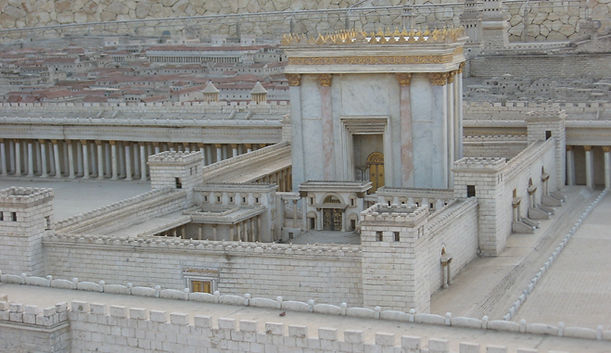
As he did with the king, God eventually accommodated the temple, and Solomon built it. This accommodation doesn’t mean the temple was without its difficulties. The risk is implied in God’s initial refusal. People may be tempted to locate God in the stationary temple and in that particular land, an assumption common among pagans with their local deities. As with kingship, we could legitimately say that the other nations had temples, and it is imitation of the nations that motivates David and later temple advocates. As such, the localized temple could become an idol, a fetish, or good-luck charm thought to guarantee blessing and security, replacing a genuine covenant relationship with covenant responsibilities.
And this idolizing is exactly what happened. While God’s people committed idolatry and injustice, they appealed to “the temple of the Lord,” in effect turning it into a “den of robbers” (Jer. 7:1–28). Jesus later quoted from Jeremiah’s temple sermon as he turned over the tables of the moneychangers in the courts of the second temple (Matt. 21:12–13). Jesus lamented for the people, but not so much for the temple, whose destruction he foresaw (Matt. 23:37–24:2). Jesus was accused of speaking against the temple (Matt. 26:59–61), a charge in which there seemed to be a kernel of truth. Jesus’ disciple, Stephen, was also later accused of speaking against the temple (Acts 6:12–14), and, true to form, Stephen contrasted the golden age of the mobile tabernacle with the decline and fall toward idolatry associated with the temple (Acts 7:42–50), culminating with his condemnation of the temple establishment and its representatives (Acts 7:51–53).
The second temple was destroyed by the Romans in AD 70, on the same date that the Babylonians destroyed the first temple in 586 BC (cf. Jer. 52:12 with 2 Kings 25:8 and Josephus, Jewish War). Jesus, Stephen, and early Jewish Christians interpreted the fall of the temple as God’s judgment (Mark 12:1-12; Matt. 22:1-14; Matt. 27:25), precisely as the Jewish prophets had interpreted the fall of the first.
As the earthly king of Israel had become obsolete by the time of the Babylonian exile, so the temple, destroyed by the Babylonians but rescued from oblivion temporarily by the post-exilic remnant, was made obsolete once again after its destruction in 70. Roman talk of its rebuilding in the 130s led nowhere, and after the Bar Kochba revolt in that decade, and especially after Muslim occupation of the temple mount in the seventh century, the idea would not be seriously revisited.
Incidentally, I have been told that there are evangelical Christians, and perhaps some Jews, who aim to have a third temple on the mount in Jerusalem. Politically, it would likely mean the start of World War III. But religiously, at least from a Christian perspective, it is at least unnecessary and, more than that, an affront to Jesus Christ himself.
For, like a king, a temple could be good, a vehicle for truth and God’s work. If temple simply means sacred space—God’s special presence for indwelling and redemption and therefore a place of worship—then there are foreshadowings and echoes of temple, as sacred space, throughout Scripture. As noted, creation is God’s temple, but also the Garden of Eden, Noah’s ark, Mount Sinai, and the tabernacle are sacred spaces. God accommodated and used the temple, as stationary building, to point to the truth about Jesus Christ, his body, and his larger creational intent.
There is no need for a temple because Jesus Christ is the ultimate fulfillment of the temple. In Christ, God comes and “tabernacles” among us, manifesting his glory (John 1:14). As true God and true man, he is God with us (Matt. 1:22-23). As he judges the inevitable abuse of the Jerusalem temple, Jesus refers to himself as the temple (John 2:19). He forgives sins (Mark 2:5-11; Luke 7:48-49), an authority otherwise associated with the temple and its rituals. Christ simply is sacred space, the mobile holy of holies. Thus, the Jerusalem temple as a place of worship, like Mount Gerizim, is of no consequence (John 4:20-24).
The church, as the body of Christ, through the presence of the Holy Spirit, is sacred space, a holy temple, both collectively (1 Cor. 3:16) and individually (1 Cor. 6:19–20). Finally, in the new creation, there is “no temple in the city, for its temple is the Lord God the Almighty and the Lamb” (Rev. 21:22). Because of God’s redemptive presence, the entire city, in fact, is sanctified (golden and bejeweled) as sacred space. God and his people are not just in the temple; they are the temple, in full communion and union, bringing to completion God’s creational intent.


